Sunday, July 14, 2013

KinoSmith Inc. Film Review - Adriatico My Love


The feel of the Mediterranean is introduced with a fly in shot off the wing of a small commuter plane over top of the Island of Hvar. The screen is filled with the multi coloured images of the roofs of the houses below, green vegetation, rock formations and aqua blue water. The next sequence transitions to snow and cold on a frozen Lake Simcoe, Ontario. TV host Alex Gull (Valerie Buhagiar) is shooting her cooking show doing a feature on Ice Fishing and her take on how to defrost your haul.  Alex's show Cook on the Go is running out of ideas leading to low ratings and this current show outing is not successful as pointed out by Claude her boss at the network.

Now at a point with nothing to loose Alex badgers her daughter Lucy(Dorian Kolinas) into heading to their ancestral home on the Adriatic to revitalize the show with or without the blessing of her producers and to re-establish a closer relationship with her daughter.
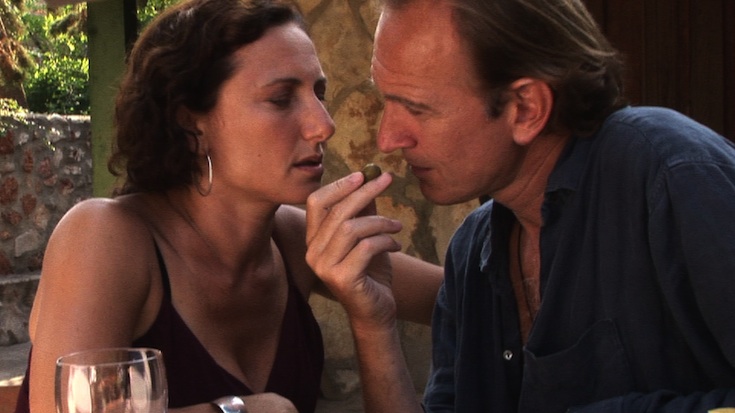


Directory of Photography Antonin Lhotsky takes a different path to presenting a film about life on an island playground. The usual practice is to use a lot of light, make most of the daytime scenes bright and the landscape vibrant and easy to absorb. Instead Lhotsky has many instances where the setting is muted, dark and shadows are very prominent.  Director Nikola Curcin story works well with this style as a good part of the opening act on the island focuses on buildings and areas of the town Stari Grad that are in disrepair amongst a narrow labyrinth of roadways.

The beginning moments do not work out well for the pair. The Gull's homestead on the island is not as expected, a spot introduced to them by the local is different from new world standards but the duo do eventually find their island legs and get into a routine for gathering footage for the show.

We learn that Alex has a personal history on the island and her choice to bring her daughter with her was more that to have her handle the camera for her show. Lucy despite her initial protests and issues she is leaving behind in Toronto settles in well on the island and meets a group of young people that she can spend time with especially Jure who she begins to spend more time with as her connection to the Island deepens.

Curcin uses a lot of locals on the film. Their inclusion gives the movie a natural feel however on some of the group shot scenes they can get caught staring into the camera.  One aspect of the film that could be better is the close up shots.  They do not appear to flow naturally in a scene and appear that they were spliced in well after a scene was shot. When they do occur and they are used a lot it takes the viewer out of the regular pace of the film.

The star of the piece is the food and the cooking sequences. The natural items used to prepare the meals and the elements used to season and spice the dishes are really well presented. The main island staples of bread, cheese, figs, grapes and wine seem to appear at every meal.  The universal ingredient Olive Oil is prominently featured and Alex's refrain Don't Forget the Olive Oil is heard throughout the piece.

The soundtrack features many traditional songs most of which are instrumental. The main song with words Nek Zaplacu Mandoline a hearty Croatian piece is used over the closing credits. Curcin uses the natural sounds, the hum of the island, birds, boat motors or the water hitting the shoreline in many scenes.

Nikola Curcin has presented a very watchable film. If you every wanted to take a trip to the Adriatic this film gives a strong flavour of the region. Some of the plot lines are similar to other North American's abroad pieces but it has enough unique elements that it's a film I can recommend.


*** out of 4

Adriatico My Love | Nikola Curcin | Canada | 2011 | 83 Minutes.

KinoSmith Productions.

Tags: Mediterranean, Adriatic Sea, Cooking, Croatia, Lipi, Mother /Daughter, Summer Romance, Romance abroad, Island Life.


Tuesday, July 9, 2013

Film Review - The Bling Ring


Sofia Coppola took the idea for this film from the Vanity Fair article The Suspects Wore Louboutins by Nancy Jo Sales about a group über rich high school kids from Calabasas, California that broke into celebrities houses in the Hollywood Hills and stole over 3 million of dollars worth of clothing, money, jewels and designer items.  The gang used celebrity news web sites to determine when their targets were at a premiere, out of town for an appearance or to shoot a film. Next they found the celebrities houses and layouts using google and google earth then headed to the homes preceded by their catch phrase "Let's Go Shopping."

Beginning with a shot of the teens in a home emptying jewellery boxes and grabbing clothes from closets. Followed by their departure unaware that their exit from the premises was being filmed on a security camera Coppola sets the tone for the Bling Rings method of pilfering and their general lack of awareness.  The scene shifts to outside of the courthouse as the media take pictures and ask questions of the ring members post arrest. One oblivious member of the group speaks to the cameras remarking that she is a firm believer in karma and this situation is a huge learning situation for me to grow and expand as a spiritual human being.


The story picks up again one year earlier where we meet two high school aged girls Nicki (Emma Watson) and her adopted sister Sam (Taissa Farmiga) being called by their mom Laurie (Leslie Mann)  both obviously showing signs of the morning after a late night on a school night. They head down to a breakfast of Adderall and Cereal to begin new age home schooling based on the The Secret from their mother along with Nicki's younger sister Emma (Georgia Rock) .

Next we meet Marc (Israel Broussard) starting day one at the dropout school Indian Hills. He meets Rebecca (Katie Chang) and they start up a friendship.  Marc is invited to a party at Rebecca as her mom and her husband are out of town. During the party the duo head out on the street to check cars one is open with a wallet containing money and a credit card easily at hand. A few days later Marc learns that Rebecca broke into a house and they head to an address of an acquaintance of Marc's who is away on vacation. The two go in and take some souvenirs. From there the pair are looking at a celebrity site and notice that Paris Hilton is out of town. They google her address, check the layout on google earth then head to her home for their first celebrity break in. The pair soon return with aspiring model Nicki, Sam and their pal Chole (Claire Julien).  Marc and Becca play tour guide to the newbies showing them where the best rooms are in the Hilton home to grab some loot.


Coppola filmed many sequences amongst the friends and in the homes by hand held camera. There is a great shot as Marc and Rebecca head up the stairs in the Hilton home (Hilton gave Coppola permission to shoot there) that is originally focused on the framed magazine covers on the circular wall then they blur and the camera switches to a razor sharp image of Marc and Becca as they ascend to Paris' bedroom. The cinematographers Harris Savides and Christopher Blauvelt used a lot of natural light for framing scenes in the movie as illustrated in the interview with Nicki and her mom for the Vanity Fair article.

One of the film's highlights is the break in at Audrina Partridge (of the the Hills fame) home. There are no inside scenes of the break in; instead its filmed outside, above and at distance. Because the Partridge house is all glass the scene is voyeuristic as Marc and Becca go from room to room up and down levels, inside and outside, opening doors going through drawers and closets in each room of the two story hillside home.

The piece is well written as a narrative. The linear story is interspaced with the ring members interviews for Vanity Fair as they recount how they became involved and their interrelationships. Nancy Jo Sales earns a co-writing credit for the movie. Its fast moving and the court case is handled by a particular unique technique setting up the beginning of the court proceedings and to signal the end and verdict.

The story does lack in character development. We meet the main characters see them commit the break ins first as a pair and eventually branching out to 6 or 7 participants. The script does not provide insight on why each member choose to get involved and no depth on Becca the Ringleader. Why was she driven to start this behaviour or why does she has no inkling that what she was did was wrong.  We learn that she is in the dropout school due to illegal substances and that she lives with her mom in L.A. while her father lives in Las Vegas.  Marc has the most in depth development, he has a confidence problem doubts about his looks and difficulty fitting in. He remarks that Rebecca is the first best friend that he ever had. He in the delinquent school because he was kicked out of his former school due to absences.

The gang treat these homes as stores in a mall shopping for items, trying things on gushing about brand name clothing, handbags, sunglasses, shoes and watches and taking what they want including prescription pills, carpets off the floor and pictures off the walls. Their need to be near and part of the celebrity culture often referring to their targets by their first name gave them notoriety in their own right. After the arrest Marc brags that he received 800 friend request on Facebook and accepted them all!  Perhaps the most telling line in the film is that of Becca when she learns in custody that the police have talked to the celebrities that were robbed and her only thought is to ask what her fashion idol Lindsay Lohan had to say about the group.


Music is a key part of the piece. The friends hang out in a popular L.A. club that features house and dance music. They have a regular table, bottle services and every legal and illegal stimulant that their fenced goods and stolen cash could buy. Rap is the preference as they drive around town; Coppola choice to have no music at all during the burglaries is very effective. The only sounds are communication between the group. Its silence other than the sounds of opening and closing door, drawers and closets plus the jingling of jewellery.

Costume designer Stacey Battat is an important contributor to the film. The cast spend the majority of their time in famous peoples closets going through there clothes, pulling designer label outfits off the racks, trying on pieces in full lengths mirrors then digging through multiple accessories from jewellery to sunglasses to expensive watches.  As important is the work of set decorator Sara Parks as the film had to recreate the interior of the celebrity homes, rooms and apartment sized closets where the treasures are found.

Coppola does comment on the cult of celebrity and the obsession with fame and famous people but there was a real opportunity to go into the psyche of the parties involved that was missed.  The film has some good points but it does not go deep enough below the surface into the subject matter to warrant a recommendation.

** out of 4.

The Bling Ring | Sofia Coppola | USA/UK/ France/Germany/Japan | 2013| 90 Minutes.

Teens, Celebrity, juveniles, Google Earth, Paris Hilton, Audrina Partridge, Orlando Bloom, Miranda Kerr,  Megan Fox, Rachel Bison  Lindsay Lohan, Home schooling, Facebook, TMZ.


Wednesday, July 3, 2013

NXNE 2013 Film Review - No Joke


What would happen if you took three comedians that were hated jeered and generally despised in their home city to another location to tell their jokes? Would those new audiences react the same or might they find the trio funny? That is the question that director Matt Frame asked as he took three Vancouver comedians on a tour down the West coast on the way to Los Angeles for individual auditions with Jamie Masada at the Laugh Factory in Los Angeles.

The comedians James Brown, Ali Hemraj and David D.J. Roy have absolutely nothing in common.  Brown appears to be the closest to a normal guy. He can get some jokes on occasion but tends to go to the racial element too often. D.J. Roy is basically homeless living on and off in a halfway house and turning to porn work on occasion for money. Roy delivers routines that on most occasions produces silence in the room. Hemraj is a terror, angry and prone to jokes about child abuse and violence that often sparks disbelief or downright anger from audiences.


The three head out on a 7 city U.S. tour down the pacific coast along with their road manager Vibrato 3.72 armed with a leather black vibrating suit and prone to giving hugs to girls so they can feel it working.

Director Frame catches the interaction amongst the three comedians and their bumbling manger as they head out on tour. They spend countless hours in the rental car and Motel 6 hotel rooms in between performances in small clubs, storefronts and impromptu sets in the street. Despite their differences the group really does get along except for only a few instances. Frame is also the main narrator of the piece discussing how the shows set up at each location, giving the order of the comedians as they hit the stage plus a couple of comments on how each set went.

James Brown as expected is polished and has the most good sets on the way to California. Surprisingly Hemraj does find the occasional audience that will accept his humour while D.J. Roy tends to struggle often commenting in the post set confessional that he could do better.

One of the high points is James Browns routine on a roller coaster displaying his relationship and race relations humour. Another is Hemraj's painful set in a San Francisco laundry where he goes hard on the racial humour in a multi cultural room. The tension during his set is palpable and it's a very real possibility that he will not make it out of the shop in one piece. A third is the sad back story of David D.J. Roy the hard times that he has seen some elements that are so bad that he would not talk about them on camera.

Frame keeps the action moving at a very good pace and does an excellent job editing the individual sets and introducing the back story of each comic as the piece moves along. A particularly good piece of editing is the voice over narration shifting back and forth between each comedian and Vibrato as they hit each city and give their view of events. Frame moves seamlessly between the characters and the voice overs flow very naturally.  He also presents the material as not to telegraph the ending at the private evaluations with Jamie Masada.

Not to be missed is the Ray Gill (featuring James Brown) interlude of T.C.O.B. ( Taking.Care.Of. Business) a guerrilla shot video on the streets of Vancouver thats featured in the James Brown back story.


At some times legitimately funny and others unintentionally funny No Joke is worth viewing. It takes a moment to get going but once they get in the car and head across the boarder the action heats up. Frame took two years to complete the production including a postscript on the comics 6 months after the tour. No Joke is a film that I can definitely recommend.

*** 1/2 Out of 4.

No Joke | Matt Frame | Canada /U.S.A. | 2013 |109 Minutes.

NXNE 2013.

Tags: Comedians, Vancouver, Laugh Factory, Road Comics, Jamie Masada, Seattle, San Franciso, Los Angeles, Ray Gill, Motel 6.


NXNE 2013 Film Review - Authentic: Young Rival's Journey Through Canada


Opening with a shot of bassist John Smith, drummer Noah Fralick and lead guitarist and singer Aron D'Alesio sitting in a backyard in Hamilton Director Brendan McCarney introduces the audience to the Hamilton not so punk band Young Rival. McCarney is back at NXNE for the second year in the row having filmed Ages & Stages: The Story of the Melgrove Band last year and he hinted that he will be back again next year for the trifecta with a film on the band Wildlife who also appear in this documentary.

The tour starts off at the Town House in Sudbury where legend has it that Stompin' Tom Connors wrote the words for Sudbury Saturday Night on a wall in the Tavern somewhere beneath the paneling. The band next heads to Thunder Bay then the rest of the tour stops are all points West. As the van heads along the Trans Canada highway the band stops at an abandon house were it's obvious that families and children were squatting in the building.  Instruments are set up and they play Nothing You Know Well.  The song is shot using the natural light coming in from the open windows and featuring close ups of the band, the holes in the walls, and the damaged plasterboard. This is the first of a series of non concert performances throughout the film where Young Rival set up and play at various off beat locations along the tour.


Director McCarney also cuts in and out of an interview the band did on CBC radio 3 in Vancouver  throughout the piece. The band discusses being on the road, their type of music that is always changing and two things that they are know for outside of their music, exchanging postcards with their fans and their Wildcat brand of wine.

The band gives an interesting perspective on records, MP3's and studio material reporting that sales are not important. The goal is to get your name and music out to the public. They would almost rather give the music away for free to the public to build a following that would come to their shows.

As they travel to Medicine Hat they met a local character Old George in White Wood Saskatchewan. On George's property he has built a city/village/amusement park out of vintage items. The band is lead into his prized building the bar where they set up and play Valerie. Drummer Noah Fralich is not able to set up his drums so he keeps time tapping on an old violin.  The band is really taken by George as they recall the event in the backyard interview vowing to return and play a full concert at the location in the future.

The film really captures the grind of the road for a small band. They go from show to show all crammed into an old van. They are their own roadies, instrument techs and stage crew.  If they don't like how a venue is set up as it inhibits people from coming to the stage or dancing.  Lead singer D'Alesio jumps down off stage and re arrange the tables in the place himself. The film directors travel as the band does and spend many a night sleeping on the floor of their hotel rooms.

Perhaps the best part of the documentary is the interaction between fellow bands on the road.  After an  incident in Winnipeg where a window is broken on the van they put out the word to the touring community and get an offer from the Sheepdogs to use their van sitting vacant in Saskatoon.  The main relationship is with the members of Hollerado who are slightly more accomplished than Young Rival but can see form their dedication to the craft that they will be successful in the music business. The band also interacts with Arkells and Wildlife the latter who along with Hollerado are part of a great prank played on Young Rival on the last day of the tour in Saskatoon.

The last of the impromptu gigs is in a brewery on Vancouver Island the owner of the brewery is another great character .  Young Rival get a tour of the brewery, then set up amongst the tanks to play Night Song.  Once again there is no space for Noah to set up drums therefore he keeps time on one of the tanks.  The owner hits another level when he learns about the wine and the band gives him a bottle of their Wildcat wine.

Authentic: Young Rival's Journey through Canada is a gritty look into the world of indie rock in Canada. It's not glamorous, bands want to play their music well aware that they could compromise and write songs that music executives and radio programmers want to hear but it would not be true to their core.

The directors capture the day to day drudgery of the road; each day a new city a hurriedly arranged phone interview as you're on the way out for breakfast followed by a show at night to a small room of hardcore rock fans. The film is an insightful account of the indie rock scene in Canada and one that I can recommend.

*** out of 4.

Authentic: Young Rival's Journey Through Canada | Mike Gillespie/ Brendan McCarney| 2013| Canada | 88 Minutes.

2013 NXNE Film Festival.

Tags: Indie Rock, Canadian Tour, Travel, Hamilton, CBC Radio 3, The Sheepdogs, Hollerado, Wildcat Wine, Wildlife.


Tuesday, July 2, 2013

NXNE 2013 Film Review - Mistaken For Strangers


Tom Berninger has a history of under achieving and not completing what he starts.  He also happens to be the younger brother of Matt Berninger lead signer of the band The National that after 10 years of struggle has finally achieved critical and popular success. The band is about to embark on a major U.S and European tour.  Matt invites his younger brother Tom to come along and be part of the tour crew so Tom decides to chronicle the proceedings on video.

Tom's appearance on tour has repercussions for everyone associated with the band.  The Band Manager has concerns with what he is filming.  The dynamic is also complicated that the other 4 members of the band are also two sets of brothers. Tour Manager Brandon Reid lays out clearly to
Tom his duties for the tour, his task is to make sure that band has every thing they need in and around the time they hit the stage. One last note, Tom has some issues with alcohol as well.


The film is more about the relationship between brothers with a nine year age difference than the day to day events of the tour. In the one on one interviews Tom constantly asks the other band members about Matt and their relationships with Matt and how they view Matt's relationship with him. He also reverts to his past nature, which causes a strain on his relationship with his brother and band management. The tension is increased as although he is a member of the crew in name he is the brother of the front man of the band.

Shot mostly with handheld camera Berninger catches the behind the scene elements of the road along with the energy of the band on stage. His focuses in on the nuance of the band during their live performances including the trance like state that his brother Matt develops on stage. Berninger himself did the cinematography for the piece.  The film has a great look especially when the band is on stage.  The lighting of the band in blue and red hues is haunting particularly during ballads. The presentation also switches between shots from the side of the stage focusing on the closest band member, to centre stage shots trained on Matt's singing. The effect gives the audience the feel that they are right in the crowd notably when the camera follows Matt as goes on one of frequent his walkabouts through the crowd. The fast cuts of the band members and the crowd in the concert scenes accompanied by the lighting effect fills the viewer's senses. Berninger even manages to capture Barack Obama for the Documentary as The National were invited to participate at a campaign stop in Madison, Wisconsin. However he was not able to meet with the President as he did not have the proper security clearance.

Tom's return home to Cincinnati from the tour and interaction with his parents is a key part of the documentary.  He interviews his mother and father on camera asking them to reflect on both boys.  They both describe Matt as an overachiever, an athlete; serious and driven while the inability to complete anything comes up again for Tom. His mother, an artist points out a picture he did as a youth that is still hanging in her studio. She remarks that he was more artistic but he needs to complete something as he always quits things.

The editing process proved to be the greatest challenge for Berninger. He marks each episode of the documentary in colour coded sticky notes which raises some concerns as he could not explain his system or the eventual order of the scenes to anyone who asked. This confusion followed a disastrous screening sends Tom hurtling towards a complete breakdown.

Mistaken for Stranger is a crisp documentary of a band on tour with the relationship between two brothers at the centre. The concert scenes are beautifully shot and give the viewer the impression that they are front row centre at a concert for The National. The energy of the band above all that of the lead singer leap off the screen. As a contrast to the star singer of a band on the rise you have his younger brother as a director who despite the apprehension of the group and the ups and downs of his mental state finally completes a project that will be a great benefit to the band and help to bring them to an even higher level. This is a film that I can highly recommend.

**** out of 4.

Mistaken for Strangers | Tom Berninger | U.S.A. | 2013 | 75 Minutes.

2013 NXNE Film Festival.

Tags: Indie Rock, Brothers, Sibling Rivalry, touring, Concert , U.S President Barack Obama, Overachieve, Underachieve.


NXNE 2013 Film Review - BB King: Life of Riley


The documentary opens with several celebrities speaking about B.B. King. Bill Cosby notes that the story of Riley B. King is one of survival. Other celebrities and musical greats including Bruce Willis Carlos Santana, Bonnie Raitt and Eric Clapton provide opening commentary about the blues legend. They speak to the distinct sound of his music that he is recognizable by only one note and the ever present vibrato.


Narrator Morgan Freedman takes over the piece to recount the main elements of B.B. Kings early years starting with his 1925 birth in a sharecropper's plantation along the Mississippi Delta. During this period we meet B.B.'s  relatives who's parents helped in his upbringing after the premature death of his mother. King himself tells the story of his early years referring to himself, as just a blues singer he sits on is tour bus headed to his birthplace for the annual B.B. King Homecoming Festival. One of his great aunts had a phonograph which was the focus of his visits to her residence. School was important to King. He had to travel a long way to attend Elkhorn School the area one room schoolhouse. He also leaned a lot musically and personally from attending church influenced by the reverend Archie Farms.  King was not immune to the realities of the era. The KKK was very active in his community and was witness to a lynching an event that had a very large impact on the young King and stayed with him to this day. His grandmother died when he was 14 and his dad brought him to Liberty Mississippi to live with his half brothers and sisters. King did not like the new surroundings and road his bike back to the Delta to stay with family friends. Back in the Delta King damaged a plantation tractor and left for Memphis for 8 month before retuning to pay off the damage to the vehicle. It was from this plantation owner that he received his first guitar.

He eventually did leave for Memphis for good at age 23 spending 5 years at WDIA records as a DJ. He went by the nick name Beale Street Blues Boy which evolved to Blues Boy then eventually shortened to B.B. King.  He played in the clubs at night, sang on the radio and cut 4 sides for Bullet Records. It was also in this period where he came up with the name for his guitar. It stemmed from a fight in a night club that caught fire during a ruckus. King ran out with the guests but retuned to get his guitar which almost caused the death.  The original cause of the fight between the two combatants a girl named Lucille.

The real start of his career was in 1955 when he started out on a bus tour with his band the B.B. King Review playing the black clubs on what was known at the chitlin circuit. This also began his reputation as a tireless tourer sometimes playing up to 360 days a year.

The director switches back to commentaries from music legends all speaking about the quintessential B.B. King's 1964 album Live at the Regal in Chicago. Many legendary mostly British guitar players from Paul Rogers to Carlos Santana to Peter Green comment on how this recording was the greatest bit of guitar work ever put on vinyl.

His manager Sid Sidenberg saw more potential and wanted B.B. to Branch out. He booked king on the 1969 tour with the Rolling Stones the tour brought king a much larger audience now playing stadiums.  Billy Wyman interviewed remembering the time and tour did not know what he was doing with the guitar and could not way copy King. Skip forward 20 years Bono speaks of the collaboration with U2 on rattle and hum where once B.B. started singing he felt like an inferior school boy and moved to the side of the stage to give B.B. his due pivotal moments in the film that point to the fact that King had to go abroad to expand his audience before he could be appreciated by the majority of the citizens back home.

A highlight of the film is an interview where B.B. speaks about his music, his peers Albert & Fred King and influences such as T- Bone Walker. The interview is cut from three different discussion from the early middle and late part of his career. Another key moment featured the 2011 concert at the White House, playing along Mick Jagger with President Obama joining him in a rendition of Sweet Home Chicago. The director spent two years working on this project and went over 250 plus hours of archival material to complete the film.


B.B. King the Life of Riley is a wonderful tale about a blues titan.  It's a piece that has great cross generational appeal. The documentary shows the level of respect that the traditional legends in rock have for a true pioneer.  It's a film that I can highly recommend.

*** 1/2 Out of 4.

B.B. King Life of Riley | Jon Brewer | U.K. | 2012 | 123 Minutes.

2013 NXNE Festival.

Tags: Blues, Mississippi, Memphis, Touring, Live Performance, Rock and Roll Hall of Fame, Chitlin Circuit, Live at the Regal in Chicagio, Rolling Stones, U2, Three Kings,  U.S. President Barack Obama , Sweet Home Chicago.


Monday, June 24, 2013

NXNE 2013 Film Review - AKA Doc Pomus


Immediate close up shot of an older gentleman speaking about how his physical limitation were not going to old him back. He was going to be the first disabled heavyweight boxer able to knock out opponents with one punch.  The speaker is Jerry Doc Pomus reading from one of the writings from his journal as he speaks singles (45's) and album covers from some of the biggest acts from the 50's though the 70's flash across the screen.  In his opening address Doc speaks of a desire to go up to someone on the street and say you know I wrote the song you're singing, humming or whistling to but never did as the person would probably not believe it. The name may not be familiar but the songwriter Hall of Fame member wrote hits such as This Magic Moment for the Drifters, A Teenager in Love, Andy Williams biggest hit  Can't Get Use to Loosing You, a slew of Elvis Presley songs including Surrender and Viva Las Vegas and Pomus' biggest hit Save the Last Dance for Me.

The scene shifts to his early life born; Jerome Felder Doc contracted polio at the age of 6 forced to use crutches from that point forward. Doc who was a very active child before the incident took to standing in the background by walls to hide the fact that he had to use crutches. He began to listen to a radio at night in bed drawn to blues music because he identified with the struggles portrayed.

At 17 he went to the renowned Pied Piper Blues Club headed up on stage unplanned and started to sing hunched over his crutches launching his short lived singing career. His most famous side (as singles were called in the day) was Alley Alley Blues a catchy and melodic song that should have been a big hit. Doc realized that the songs he sang did not match the visual the audience expected therefore he turned to writing.


Directors Peter Miller and Will Hechter use several old photographs to present the early days of Doc Pomus. Old photos of the Brooklyn neighbourhood,  the camp where his family sent him to avoid the polio outbreak and ironically the spot here he caught the disease. Family photos of his father mother and younger brother and the apartment building where the Felders lived.

Doc was the king of the New York Hotel lobby. He was particularly associated with the Legendary Forest Hotel.  Often planting himself in the lobby for the majority of the day as people gravitated toward him. One of these people was Willi Burke who was drawn into his circle and eventually became his wife.  Doc would write songs and try to sell them to the publishing houses. One of these Young Blood  he found in a jukebox reworked as a song for the Coasters when he was on his honeymoon with Willi.  He called the publisher he sold it to who remarked  guess you want some money and gave him his first real royalty cheque.

The other main structure associated with Doc is the Brill Building.  The famous New York City landmark located at 1619 Broadway Avenue that was full of publishing companies and songwriters in different offices from the basement to the 11th floor.  At the peak of his writing prowess in the mid 60's Doc ran the building having exclusive access to the penthouse with his writing partner Mort Shuman.

The Directors recount the story mainly though recorded interviews from the 80's featuring Pomus. The recordings are authentic grainy and sometimes lacking clear sound. Another large part of the piece are the reading from Doc journals that show he was tortured more by his need to write songs over his physical afflictions. In one of the 80's interviews,  he describes that he did not want to write songs but he had to write songs. Doc explains that it's a terrible force that is sometimes out of control which  makes you keep writing even though you will not make any money and know no one will care.

The film produced by his daughter Sheryl tells the story of a man who's songs you know even though his name may not always appear on the record. It looks at all aspects of his life, the early years, his peak in the mid sixties, a fall into reclusiveness into the seventies and a rebirth co writing with Dr. John in the mid to later part of that decade and into the eighties. The film mentions some musical heavyweights such as John Lennon, Bob Dylan and Phil Spector but these subjects are not really developed.

The documentary has some good moments but could use some better pacing and audio qualities. The narrative also suffers from a narrow field of view.  If you're a fan of the ballads of that era it's a good view but not one that I can recommend for the general viewing public.

** Out of 4

AKA Doc Pomus | William Hechter, Peter Miller | Canada / U.S.A. | 2012 | 98 Minutes.

2013 NXNE Festival.

Tags: Polio, Blues Singer, Song Writers Hall of Fame, Brooklyn,  The Brill Building, 1619 Broadway,  New York Forest Hotel, The Coasters, The Drifters, Ben E. King, Elvis Presley, Ray Charles.