Sunday, March 29, 2015

RAFF 15 Film Review - Beltracchi: The Art of Forgery

The film opens with interviews with the principals involved with the painting that brought down Wolfgang Beltracchi's forgery career. They discuss the fate the forger should face. Each has a harsher sentence that the next with the most extreme being Kunstahaus Lempertz owner Hendrik Hanstein who recommends punishment under Muslim Sharia law. In fact Beltracchi received a 6 year prison sentence for his crime of selling 47 million in fake art over a 40 year period but after a year and a half was allowed to spend his days in his studio working on pieces as he attempts to pay back the 27 million he now owes through law suits.

As with any con man a big personality and extreme confidence is a must.  Beltracchi has both in abundance. As he tours around his studio he reflects on works of his main target Max Ernst along with other masters commenting on how easy it is to re create their work and in fact his versions of their works or his inspired creations to fill in gaps in an artist catalogue are better that the original works of the artists themselves. His wife Helene was a vital part of the plan. The pair met in 1993 and Helene soon fell in step with her husbands work.  Helene was front and centre in the couples biggest scam.  A claim that her grandfather had hid his art collection from the Nazi's before the war that she inherited at his death. Only there was no collection only works by Beltracchi's filling in gaps in targeted painters catalogues.


Director Arne Birkenstock basically says Action the hits lets Beltracchi roll full on. The story follows Beltracchi as he goes through the process of creating a forgery. Mixing period appropriate pigments, foraging though flea markets for early 20th's century picture frame preferably with dealer stamps on the back of the frames. Birkenstock  shows Beltracchi's technique for removing the original painting from the frame to leave a blank canvas for his work.  Lastly the forger's finishing aging steps are displayed including adding dust to the inner nooks and crannies of the frame to give that bumpy feel that one expects as they run their fingers over the frames's outer edge. Birkenstock uses a lot of long shots when filming the work in the studio. Overhead shots are also prevalent to show the scope and physicality of the work.

It turns out that the protagonist was tripped up by a moment of carelessness. He used a tube of white paint for his lost Campendonk creation Red Painting with Horses 1914 that contained a titanium white pigment that would not have existed in Campendonk's era. The mistake led to a police investigation and arrest as the family headed for an evening out. Beltracchi's teenage children were in the vehicle and it was the first time that they learned that their dad did not have a legitimate job in the art word.


Birkenstock also exposes the seedy underbelly of the High Art world.  The auction houses make millions in commissions along with the authenticators. The collectors are greedy for the prestige of owning a unique work of a master. So all parties have a vested interest for the paintings to be real. Couple this with the inexact science of authentication makes it relatively easy for forgeries to reach galleries, private collections and museums.

Beltracchi: The Art of Forgery is an enjoyable production that is entertaining viewing whether you're an Art world insider or know nothing about art at all. Director Birkenstock creates a relaxed environment for his frank and open protagonist to tell their story. The charismatic pair committed crimes but somehow it seems that the people the pair duped were entwined in a system that is full of holes.  It is a film that I can recommend.

*** 1/2 out of 4.

Beltracchi: The Art of Forgery | Arne Birkenstock | Germany | 2014 | 93 Minutes.

Art, Forgery, Crime, Documentary, Max Ernst, Heinrich Campendonk, Art Gallery, Auction House, Sotheby's, Christies, Authenticators.






Thursday, March 26, 2015

HRWFF 15 Film Review - The One That Got Away

Thomas Beck lives for today. He does not dwell in the past and has not time for hate. His philosophy is to spend as much as he has or on occasion more than he has and surround himself with young people.  Now in his 80's he still does 50 pushups a day as part of his callisthenics. Tomi developed this attitude due to the many times he faced death directly as a child.  He is a survivor always doing what he needed to survive along with a knack to leave a situation before it turned completely for the worst.

In his teens Thomas was separated from his family and interred by the Nazi's in a camp for children in Hungary, The children were given very limited rations many worried about the fate of their parents and grandparents.  It's in the camp that he meet Edith Greiman. They would spend their nights huddled together. It was through their contact that each were able to survive the situation and the war.
Each were approached by camp guards and given the opportunity to escape arranged by concerned relatives. They did not know whether or not the other survived until 60 years later when they both settled in Australia, Thomas in Sydney, Edith in Melbourne.


Edith is the worrier to Tomi optimistic outlook on life. She was taken away from the Nazi's at 14 to be interred in the same camp as Thomas. After her escape arranged by a favourite Uncle, Edith  spend much of the remainder of the war hiding in a cellar at a farmhouse. She had one book to read Robinson Caruso that she must have read hundreds of times before it was safe to come out during daylight hours. At the films opening her Husband and father of her four children Saul had just passed leaving Edith in a depressed state. She was not alone but lonely in her big empty home.

Directors Sam Lawlor and Lindsay Pollock started with Thomas Beck on the project. Due to the film Thomas was able to reconnect with Edith. Thomas had not returned to Hungary or Europe since the war but was willing to go back to tell his story for the documentary. The directors use a mix of old pictures and live exploring by Thomas to old and mainly abandoned sites in Hungary where negative events or deaths occurred in his family.  One particularly sad location is a nunnery where there is a memorial for a group of girls killed after a raid by the Nazi. Thomas finds his half sister in the group photo of the girls.

The One that Got Away is a touching story of two survivors who's worlds were torn apart in their early teens. They sought comfort in each other during their darkest days and both managed to live full and satisfying lives on the other side of the planet from the site of their worst memories. They did not know whether the other had survived but through the documentary were able to reconnect and rekindle the close feelings they had in the Camp three generations ago. It is a film that I can definately recommend.

*** 1/2 Out of 4.

The One that Got Away | Sam Lawlor and Lindsay Pollock | Hungary /U.K. | 2013 | 70 Minutes.

World War II, Jewish, Nazi, Australia, interred, hiding, fugitive, survivor.

Sunday, March 22, 2015

Dreamworks Film Review - Home

Oh (Jim Parsons) is a member of the alien race The Boov who've been running from their arch enemy the technically advanced Gorg for as long as most Boov can remember. The Gorg follow the Boov from planet to planet destroying every new home the Boov inhabit. At the films opening the Boov have target Earth as their next residence where they hope to finally escape their pursuers.


The Boov are proud of their cowardice and their leader is Captain Smek (Steve Martin) the best of their species at running away. Oh is not popular among his kind his name is based on the exasperated expression muttered by other Boov when he makes a suggestion or offers an opinion. After learning three or four facts about humans the Boov arrive on the planet politely using their suction tube technology to relocate the humans to a small section of Australia. The rest of the planet including all of the key capitals and large cites are taken over by the Boov. As his species are settling into their new surroundings Oh makes an error that could result in the Gorg learning their new location.  Oh is forced to flee running into the only human left in the city, Gratuity Tip Tucci (Rihanna) who is looking for her mother Lucy (Jennifer Lopez) relocation spot.  The pair join forces, Oh needing Tip to escape while she needs Oh's assistance to find her mom.

Director Tim Johnson creates an animated film that is entertaining for both children and adults.  The production is well paced and the action sequences on come off smoothy. The script adapted by Tom Astle and Matt Ember from Adam Rex's book The True Meaning of Smekday is peppered with subtle jokes for the adults and clean lines that will prompt reposes from all ages.  The script has several good lessons including not judging people before you know them and not blindly following leaders without critical questioning.


Jim Parsons is strong in his voice work debut as Oh. He delivers his lines well bringing his character to life especially when exaggerating the Boov's habit of slightly messing up human expressions that could grow tiresome in the wrong hands. Rihanna not only plays Tip but also did the soundtrack for the film. She is memorable as an outsider from Barbados just settling into her new surroundings when the Boov's vacuum tubes sucked up her mom taking her away. Steve Martin is his usual solid self as the cowardly yet mean Captain Smek.

Home is an enjoyable well presented fast paced. The story and visuals will appeal to the younger set plus the film includes just enough smart dialogue to keep parents engaged.  Jim Parsons and Rihanna perform well in their first voice work roles. The story is straightforward, two misfits team up to teach each other that contrasting groups can learn from each other and embrace their differences. The film has a couple of thematic threads that are beneficial to learn at a young age or as a grown up.  It is a film I can recommend.

*** out of 4

Home | Tim Johnson | U.S.A. | 2015 | 94 Minutes.

Tags: Aliens, Invasion, Search, Family, Outcast, Outsider, Immigrant, Tolerance.

Sunday, March 1, 2015

Film Review- Focus


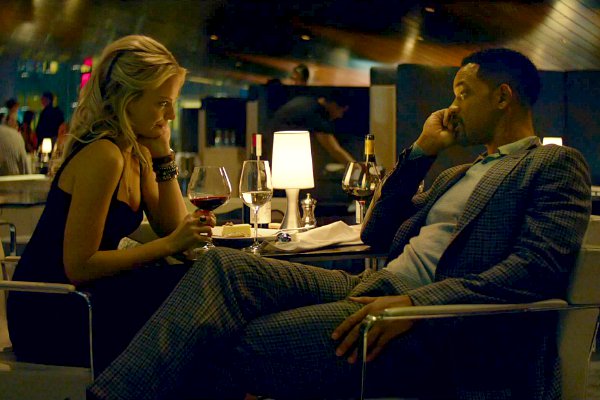
Never drop the con die with the lie is the mantra of third generation confidence man Nicky Spurgeon (Will Smith). Nicky meets Jess Barrett (Margo Robbie) at a hotel bar in New York City. Nicky is in the bar because he landed a table at an exclusive restaurant posing as a famous chef while Jess picks out Nicky as a rescuer to escape a mauler hitting on at the bar. Jess tries to run a scam that a veteran Nicky easily catches then gives her a few tricks of the trade before he departs for the Big football game XVII in New Orleans.

Jess follows finding Nicky in another hotel eating establishment the joins the crew as an interim. She gets to know the players on Nicky's crew as they lift wallets, watches and credit cards from easy unaware marks in town for the big game. Husbands looking for a good time and groups from out of town landing on the hour at Louis Armstrong airport are prim targets for Nicky's crew. They are not interested in the big retirement score but rather looking for volume as they ply their craft in the streets of the French Quarter and Hotel lobbies in the Big Easy. After a very successful week the crew makes one final play on game day that is a risk but has the capability to turn into a large reward.


The narrative shifts to Buenos Aries a good while after the events in New Orleans.  Nicky is working for Spanish race team owner Garriga (Rodrigo Santro) that has a new technology he is looking to implement but one team owner McEwen (Robert Taylor) is standing in his way. The pair hatch a plan to deal with the disgruntled team allowing Garriga to freely use his technology on the circuit. As Nicky is about to put the plan into place Jess shows up as Martinez's girl turning the events upside down along with the two heavies  Garriga's Owens (Gerald McRaney) McEwen's Jared (Dominic Fumusa) who are not Nicky's biggest fan.

Writer Directors Glenn Ficarra and John Requa present a fast paced caper that thrives in the opening part of the film. The story has habit of placing key scenes in hotel lobby bars and restaurants for  building into the transient nature of those engaged in the profession. There are no meetings at the office or a residence as con artists tend not to be in one local for a long period of time. Cinematographer Xavier Grobert pushes the blue's grey's and silver's to give the film a high end look painting a world of money, toys and status that that con artist always wants to display to the world. The sequence of multiple running games and cons at the fictional AFFA Big Game XVII week in New Orleans probably needs a rewatch to catch every rapid-fire pickpocket and bag swipe that appears on screen in a 5 minute span. The credit for the delicate ballet goes to Apollo Robbins The Gentleman Thief as consultant and choreographers of the original sleight of hand maneuvers


Will Smith is solid as Nicky. He is believable in the role getting  off a few Smith trademark jokes but his performance does leave a lingering thought that there could be bit more he could have given to the role.  Margot Robbie continues her accession to the position of it girl in Hollywood. She handles the role of Jess well switching back and forth from naive intern to junior con to the one running the rouse.  Gerald McRainey is notable as the heavy for Garriga Owens. He is crusty does not like the work ethic of Nicky's generation and the main force along with Robbie that keep the second half of the film going.

Focus is an entertaining film. The story moves on multiple levels and layers that could loose some viewers with the twists coming on a loop right to the closing scenes. The two main locations New Orleans and Buenos Aires are suitable for the jet setting fare. The cast do a good job with the material making it a film I can recommend.

*** out of 4.

Focus | Glenn Ficarra / John Requa | U.S.A. | 2015 | 104 Minutes.

Tags: Confidence Man, Crime, Football, Auto Racing, New Orleans, Buenos Aires,  Father -Son, Teacher - Protege.


Saturday, February 14, 2015

TBFF Film Review - Sound of Torture

Meron Esefanos sits at a sparse desk at her home in Sweden. The Eritrean ex-pat is on the air with a cell phone in hand. She is talking to a desperate woman on the other end. The woman had been kidnapped in the Sinai Desert and was being tortured as they spoke. Her Bedouin captors encourage calls to family relatives or Meron's radio program Voices of Eritreans hoping that their screams of pain will encourage ransom payments up to $25,000 dollars.

Sound of Torture is a harrowing tale of abuse, rape, burnings, beatings psychological and emotion torture placed on a people who are attempting to escape from a brutal military regime in their home land. The Eritreans that managed to escape in prior years could go to Europe to seek refuge.  But the European nations closed their borders leaving a trek across the Sinai Desert to Israel as the only way out. During the journey Eritrean men, women and children are hunted by the Bedouins captured then taken to torture houses where the atrocities are inflicted.


Director Keren Shayo trains her lens on several different Eritrean nationals but the story mainly focuses on two women. Hiryti who was just about to give birth when captured and the desperate voice on the other end of Meron's phone at the films opening and Timnit just out of her teens who disappeared 18th month prior somewhere near the Egypt Israeli border. The central figure in the story is the afore mentioned Estefanos who wandered into the desperate plight of these people almost by accident. She had a caller on her show who was talking about the situation in the terror camps. Meron questioned the validity of the callers comments. The caller gave her a legitimate number to call that put a camp prisoner on the other end of the phone.

The narrative sharpens when Meron decides that she has to see events unfold in Tel Aviv. Once on the ground she meets members of the Eritrean community including several people that she regularly talked to on the phone or over the air. Now in the area Estefanos turns to one of her main goals to venture out to the area of the torture camp disguised in traditional Muslim attire. In the area she finds discarded clothing of men, women and especially children along with torn garments stuck in the fencing separating Egypt and Israel. She is also determined to track down the missing pieces to Hiryti and Timnit's stories.


The members of the Eritrean community are happy to be in Israel. They are no longer being tortured but their fates are not settled. Meron meets several community members that show her the permanent torture scars. Even the psychological scares are evident in body language and physical reactions. They have no status in Israeli, no work permits are known as infiltrators and are subject to deportation back to Eritrea if they come into conflict with the law.

Sound of Torture is a detailed looks into a little publicized story. The documentary features real conversations and interviews with Eritrean ex-pats and recordings of conversation with victims as they are in prison. It also highlights the different fates of Eritrean's like Meron who was able to get out and go to Sweden vs those who left after Europe shut their borders and their options are persecution at home, potential kidnapping on the trip across the Sinai or at best living undocumented in Israel with the threat of deportation constantly over your head. The film is a powerful account of the fate of a people and one that I can highly recommend.

*** 1/2 Out of 4.

Sound of Torture | Keren Shayo | Israel / Egypt / Sweden | 2013 | 58 Minutes.

Tags; War, Kidnapping, Eritrea, Sinai Dessert, Tel Aviv, Ransom, Torture, Disappeared, Undocumented, infiltrators.


Friday, February 13, 2015

TBFF Film Review - The Supreme Price

Hafsat Abiola is fresh off a plane returning home to Lagos Nigeria at the start of the film. Abiola has been out of the country for an extended period of time due to events that started in motion when her father M.K.O. Chief Abiola ran and won the presidency in a free election in 1993. Her dad was soon imprisoned after another in a series of military coups followed by the murder of her mother Kudirat in 1996. Her mother fought for women's rights in Nigeria and to free her husband as the rightful President of the country.  It's with this history and memories that Hafsat has returned to her homeland to take up a political post and her mother's cause.


Director Joanna Lipper's film explores the major political and social issues in the country. Lipper traces the countries' history going back to the 1960 independence from Britain followed by the 23 years of military rule spanning from 1966 until1993 when Hafsat's dad won the free election but never took office. She also looks at the social aspect starting with the Muslim tradition of a husband being allowed up to 4 wives. Hasfat's mother Kudirat was the second of her father's wives and relatively quiet until her services were called upon to campaign for her husband in her home territory during the 1993 election campaign.

Women in Nigeria were a key demographic in change. They lead the protest movement with their actions. Kudirat lead a workers strike at the lucrative government oil fields. They shut down the markets, staging naked protests uniting Nigerians across regional and religious differences. Dealing with religious attitudes and traditions is always a delicate issue. In the Muslim tradition women are directed to pray at home or even more specific in their bedrooms. Therefore for a woman prayer in your yard is not as desirable as on your from porch which is less desirable than in your living room not to mention at a Mosque where all of the men go to pray. This reality along with the four-wife tradition made it hard for women to strive for equality. Even Hafsat's brother who is up to three wives at the time of filming does not feel that his sister should be in politics. He admits that the men that are running things are not doing a good job but thinks that Nigeria can find better ones before needing to consider women.

Lipper presents historical footage of the different dictators over the years and media reported of the 1993 election as part of her film. She shows Hafast time at school in the United States then her comfortable home life in Belgium with her Husband and two young children before she makes the decision to return to home to accept a suburban Lagos government position. Lipper uses effective graphics and timelines to show the history of military dictators and the ethnic and religious diversity  of the country.

The Supreme Price is a comprehensive account of the volatile history of a relative recently independent nation. Hafsat Abiola the daughter of the only freely elected President gives complete access to her personal and families story to the director. The story presents the social and political facts and events of the country in a gripping and compelling manner.  It is a film that I can recommend.

*** out of 4.

The Supreme Price | Joanna Lipper | U.S.A. /Nigeria | 2014 | 75 minutes.

Tags: Africa, Nigeria, Documentary, Independence, Military Coup, War, Activism, Religion, Democracy, Protest.


Sunday, February 8, 2015

TBFF Film Review - Manos Sucias

Delio (Cristian Abvincula) is 19 years old, a new dad and an out of work fisherman in Buenaventura Columbia. Delio spends his days practicing his rapping style dreaming of making it big in the music industry. Through an introduction he meets Don Valintin who sets him up with a job towing a hollowed out torpedo full of narcotics up river to a handoff point for some fast cash. Delio cohort in the venture is an older brother from town Jacobo (Jarlin Javier Martinez) who wants to get to Bogota since he sees no future in his hometown.

The story is very straightforward but takes some time to get going. Delino is happy go lucky constantly smiling and looking to give is the other guy the benefit of the doubt. The elder Jacobo having seen the criminal and violent elements in the town through the actions of both paramilitary and guerrilla forces is more stern and suspicious.


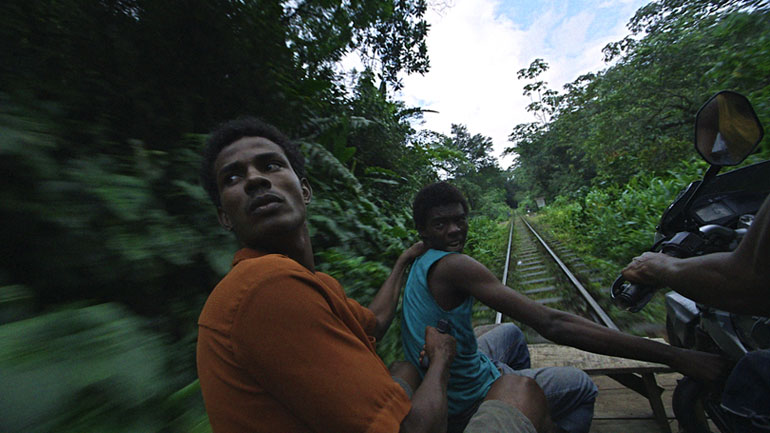
The narrative picks up well into the journey when the pair's cargo is threatened. The duo have a short time to react and recover as the transfer is set to occur at sundown that day. Writer cinematographer Alan Blanco is at his best showing life along the river. The look of the production peaks as the camera trains its lens on normal village activities along the riverbank as our protagonists motor by. Director writer Josef Wladyka excels at building tension in a scene. A strong example is a sequence where our heroes run into a guerrillas patrol while riding the rails on a Brujita. Delino and Jacobo have to move the Brujita to the side while being questioned by the guerrillas. They are particularly at risk since they are not from the area and the local with them had just put a major obstacle in their path to complete their job.

Another key element in the story is the disconnect between Afro and Latin Columbians. They argue over who is the better soccer player Pele or Zico.  The debate is emphasized in one fireside argument with Latin-Columbian Hector (Hadder Blandon) who is the link to gang that provided the job. Then again when Delio cannot understand why Jacobo wants to move to Bogota because as he states repeatedly that there are no black people in the Columbian capital unless they are doing manual labour.


The two main actors are a good fit for their roles. They spend a lot of time together on the boat, sing traditional local songs and change in their initial opinions as the story progresses. Jocobo is hard on Delio and the ways of his generation at the outset but at an early moment of truth he is there to defend his brother. Delio's trusting persona slowly drifts away leading to a critical moment when he has to make a major decision to protect the pair that is far from an act of a happy go luck individual.

Manos Sucias is a basic story with a few twist and turns. After the action picks up the film finds its rhythm and the audience becomes invested in the fate of Delio and Jacobo. Josef Wladyka presents a story seen from viewpoint of Afro-Columbian youth.  If you have an interest in the region and hang in during the slower early parts of the narrative then the film is worth a watch.

** 1/2 Out of 4.

Manos Sucias | Josef Wladyka | U.S.A. /Columbia | 2014 | 84 Minutes.

Tags: Narco torpedo, Smuggling, Crime, Buenaventura,  Fishermen, Rapping, Paramilitary, Guerrillas.