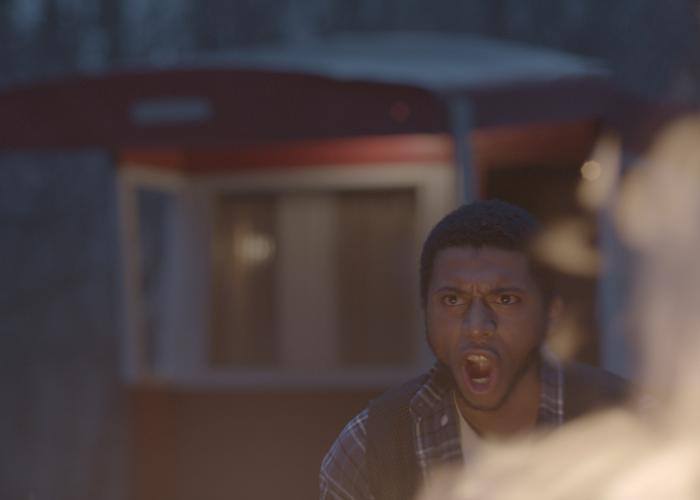
What if you lived in a world where a disease spread where once infected you lost all long-term memories and had no ability to sustain new ones. That is the premise of Embers from rookie director Claire Carre. The world has suffered a catastrophic global event leaving the survivors to fend for themselves seeking shelter in the hollowed out buildings and abandoned cars. People experience the memoir loss differently depending on their age. If you were a kid then your stuck at an infant, toddler or juvenile mental capacity as opposed to a lesser effect on a fully developed adult brain.
Ben and Jenny know they are connected because they wake up together but have no idea why. They have a blue plaid string tied to their wrist serving as a tangible link. Each day begins with picking names for each other followed by an enjoyable day falling in love again then pledge, not to go to sleep as they will have no memory of the day.
Director Carre starts with the thought of how precious memories are to each individual person. Different people can experience the same event but their perception and point of view creates a unique memory. The narrative also includes the story of a father and daughter that escaped the disease by bunkering below ground. The daughter is willing to take the risk and leave to experience the outside world while her father is well aware that once outside they all likely loose their memories that make them who they are.
Locations play a key role to establish the mood of the film. Two distinct ones are used to set the tone naturally for the natural deteriation of an abandoned urban environment overrun by nature and a vast countryside outside of a city where the bunker is located.
Jason Ritter and Eva Gocheva make a fine pair as the lovers that rediscover each other each day. They are part detective as they start a day by figuring out how they fit. Part explorer as they trek through abandoned buildings, recreation centres and churches and soul mates ending the day in a passionate embrace. Tucker Smallwood is notable as the professor James Robertson. He has rigged yarn all around his rural property to remember routes to and fro. Most of his day is spent scouring his scientific books trying to work through the problem of memory loss.
Embers is a film about the loss personal memories. The story touches on the upside of losing a painful or negative memory, which serves as valuable a plot device. Director Carre brings the audience into the action at the moment when the lovers rise to start a day thus seeing the world as Ben & Jenny. This choice shifts the viewer's progression from behind, to level to ahead by the next daybreak Severe Amnesia is concept that has been explored before most notably in Christopher Nolan's Momento. However this time its presented on a massive scale.
*** Out of 4.
Embers | Claire Carre | U.S.A. | 2015 | 85 Minutes.
Tags: Anterograde, Retrograde, Amnesia, Memory Loss, Ruins, Rape, Lovers, Bunker, Sci-Fi, Disease, post apocalyptic.
Reviews & Commentary on Film Festival Screenings, Select New Releases and Contemporary Foreign Film.
Sunday, July 24, 2016
Fantasia '16 Film Review - Fourth Place
Joon-ho (Jae-Sang-Yoo) loves to be in the water to swim freely for the enjoyment. He swims the 200 freestyle in school competitions but due to a lack of focus and concentration in races always seems to finish in fourth place. His mother Jung Ae (Hang-na-lee) grows increasing distraught with each fourth place finish. She wants Joon-ho to win metals, go to University on a swimming scholarship and bring prestige to the family. The film's prologue shot in black and white flashes back to successful Korean athletes in the late 1990's bringing glory to the country and pride to their families. We meet Gwang -su (Have Joon- Park) a leading swimming hero of that time who's talent made him a nation record holder despite a horrible training habits. After he returns from a 10-day stint of missed training sessions days before an international meet his coach employs extreme corporal punishment that results in Gwang-su walking away from the sport.
16 years later Hang-na-lee turns to Gwang-su to train her son one on one to elevate him to the top of the podium. Jun-ho' daydream attitude persist angering Gwang-su leading him to employ the same corporal punishment that had be administered to him. In Gwang-su mind if his coaches had been harder on him he would have had full glory of a swimming career himself.
Director Ji-woo Jung makes a strong statement on corporal punishment, which has been always a decisive issue in South Korea. Jung film strongly shows that its the not the way to train or discipline a child. The director makes sure to include a complicit parent in the willing to look the other way as long as the practice achieves the desired results. The productions team breaks new ground filming the swimming races. There are three main races in the piece and each is shown differently bring the accidence closer to the actions with each successive race culminating with the last one where the viewer is literally in the pool with Jun-ho.
Cinematographer Kang Min-Woo work warrants special mention. His work with the underwater swimming scenes especially the sequence after hours is truly memorable. Woo's use of light in the pool and the reflections peeking though the coiled lane ropes give the impression that a spaceship has landed on the surface of the water with Joon-ho swimming around freely in the depths below.
Hang-na lee leads the cast at Joon-ho's mother. She wants her son to win medals and will do anything within her power to make it happen. She is aware of the treatment her child is enduring under his new coach but after a second place finish the first time out off the shoot chooses to ignore her sons suffering. Hang-na lee actually remarks that she would rather see her child get beaten then come in fourth place.
Fourth place is a raw brutal and frank presentation of corporal punishment used as a motivator in Korean society. Director Ji-woo Jung is clearly against the practice using this story as an educational piece to his fellow citizens. The easy by which former victims pass down the practice is also highlighted in the production. The film presents a strong lesson for athletes, students, coaches teachers and parents alike.
*** 1/2 Out of 4.
Fourth Place | Ji-woo Jung | South Korea | 2015 | 116 minutes.
Tags: Swimming, Competition, Corporal Punishment, Gambling, Olympic Hopeful, Reporter, Medals.
Friday, July 22, 2016
Fantasia '16 Film Review - I, Olga Hepnerova
Olga Hepnerova is not a normal 13 year old girl which is obvious from the first moment she appears on screen. Olga refuses to go to school because she doesn't feel like it then takes an overdose of meprobamate to prove her point. After a visit to the hospital to have her stomach pumped her mother delivers the first of many psychological attack of the film when she remarks to commit suicide you need to have a strong will something you certainly do not have. Her family ships her off for a stint at a mental hospital for youth where she encounters same sex coupling and under age smoking for the first time. Olga suffers gang beatings in the shower after she declares that everyone should stay clear. Her quiet time in the hospital is spent reading depressing literature.
Upon her return home Olga becomes more distant from her family. Her birthday wish is to get away from her family. Shortly thereafter she sets up house in a small cabin then starts to take several laborious jobs before settling in as a truck driver. On the personal side Olga realizes that she is a lesbian beginning to openly explore her sexually although she refers to herself as a sexual cripple.
Rookie writer/directors Petr Kazda and Thomas Weinreb craft their film based on a true story. Their Protagonist on July 10, 1973, drove a truck intentionally onto a Prague sidewalk at a trolly stop mowing down 20 citizens eight of whom died. Before she committed the act she mailed out letters to the local newspapers stating that she is sentencing humanity to death for the bullying she had endured throughout her life. The directors chose to shoot their film in black and white which gives the production a sharp, crisp and clean look. An additional by product of the colour palate along with the antiquated eastern european amenities gives the the viewer a strong feeling of the old Eastern Communist block.
Polish newcomer Michalina Olszanska immerses herself in the title role. She developed a special fast paced restricted shoulder walk, sported an exceedingly bad bob haircut and a unique way to hold and smoke a cigarette that fits her character. She plays Olga throughout the entire film from the age of 13 until her execution at 23. Klara Melishovka is very understated as Olga mother. She delivers biting lines to her child but when her daughter lashes out in her direction most of the time the response is silence or indifference. Martin Pechlat has a supporting role as Miroslav. A hard drinking older Communist worker who seems to be the only person that Olga can maintain a friendly relationship with throughout the piece.
I, Olga Hepnervoa is a somber and dark tail of a neglected and abused girl who was always on the verge of pushing back until she did finally did so on a July day in 1973. The old world communist setting plays a big part in the film as does the concept of bullying which is a frontline concept in todays society. Michalina Olszanka star continues to rise with this performance alongside her work in The Lure also released this year. The directors handle a very tough and difficult subject matter in subtle manner leaving some of the more harsher elements off screen. The story does have some slower passages and focuses in a bit too much on the lead characters quicks however overall it's a film I can recommend.
*** Out of 4.
I Olga Hepnerova | Petr Kazda / Thomas Weinreb | Czech Republic, Poland, Slovakia, France | 2016 | 105 Minutes.
Tags: Murder, Psychopath, Bullying, Prague, Communism, Comrade, Driver, Lesbian, Trial, Hanging.
Upon her return home Olga becomes more distant from her family. Her birthday wish is to get away from her family. Shortly thereafter she sets up house in a small cabin then starts to take several laborious jobs before settling in as a truck driver. On the personal side Olga realizes that she is a lesbian beginning to openly explore her sexually although she refers to herself as a sexual cripple.
Polish newcomer Michalina Olszanska immerses herself in the title role. She developed a special fast paced restricted shoulder walk, sported an exceedingly bad bob haircut and a unique way to hold and smoke a cigarette that fits her character. She plays Olga throughout the entire film from the age of 13 until her execution at 23. Klara Melishovka is very understated as Olga mother. She delivers biting lines to her child but when her daughter lashes out in her direction most of the time the response is silence or indifference. Martin Pechlat has a supporting role as Miroslav. A hard drinking older Communist worker who seems to be the only person that Olga can maintain a friendly relationship with throughout the piece.
I, Olga Hepnervoa is a somber and dark tail of a neglected and abused girl who was always on the verge of pushing back until she did finally did so on a July day in 1973. The old world communist setting plays a big part in the film as does the concept of bullying which is a frontline concept in todays society. Michalina Olszanka star continues to rise with this performance alongside her work in The Lure also released this year. The directors handle a very tough and difficult subject matter in subtle manner leaving some of the more harsher elements off screen. The story does have some slower passages and focuses in a bit too much on the lead characters quicks however overall it's a film I can recommend.
*** Out of 4.
I Olga Hepnerova | Petr Kazda / Thomas Weinreb | Czech Republic, Poland, Slovakia, France | 2016 | 105 Minutes.
Tags: Murder, Psychopath, Bullying, Prague, Communism, Comrade, Driver, Lesbian, Trial, Hanging.
Fantasia '16 Film Review - Psycho Raman
Raman Raghav was a notorious serial killer in Mubai back in the 1960's. He confessed to 41 murders but before doing so made some very unorthodox requests of police. Rajhav was to be the subject of directors Anuraj Kashyap film but the scale of completing a story from the sixties gave way to a modern tale of foils of Psycho Raman. Kashayap gives a wink to his former project at the films opening and there are sprinklings of Raghav facts throughout the piece.
The criminal Ramanna (Nawazuddin Siddiqui) and cop Raghaven (Vicky Kaushal) first meet 2 and a half years before the main story takes place. Ramanna makes his first kill of an "Uncle" of Raghaven who stumbles on the scene reaps the rewards of Ramanna's actions but is forced to silence a witness as Ramanna hides watching sensing an immediate kinship.
The story continues to unfold with the pair circling each other using virtual the same methods but because Raghaven has a badge and is a respected policeman his violent actions and reckless behaviour is accepted if not applauded. Rammana on the other hand wonders the slums dragging a tire iron behind him openly admitting to his growing body count to strangers.
Director Anuraj Kashyap continues his string of high wire violent films with an over decibel soundtrack. However unlike his Gangs of Wasseypur Kashyap keeps the graphic violence mainly off screen. The narrative of a cop and a criminal being two sides of the same coin has been seen before but here Kashyap goes further linking his leading men to a point where they effectively share each others experiences. One of the standout plot points is an old fashion foot chase through the Mumbai slums.
Nawazuddin Siddiqui continues his roll of standout performances as Ramanna. He can communicate full evil with a look or a gesture but the next moment sell himself as a snivelling victim of a group attack. He plays dumb when it serves his purposes, asks questions at the level of a police interrogator when needed but is at his scariest when he calmly and unemotionally takes someone's life. Vicky Kaushal does a credible job with his material in the film. He's the hotshot police detective that can have his pick of any girl in any club in Mubai. During the day crime scenes are held until he shows up to investigate. Kushal best moments occur when he battles his internal demons especially the continued open disappoint of his parents on how he lives his life.
Psycho Raman is a psychological thriller that shines a different lens on a tried and true storyline. Director Anuraj Kashyap's fingerprints are all over the production. His muse Nawazuddin Siddiqui commands the screen and his bi-play with Vicky Kaushal are worth a look.
*** Out of 4.
Psycho Raman | Anuraj Kashyap | India | 2015 | 133 Minutes.
Tags: Serial Killer, MDNA, Disco, Tire Iron, Mumbai, Detective, Slums, Pedofile, Brother/Sister.
Thursday, July 21, 2016
Fantasia 16 Film Review - The Alchemist Cookbook
Sean (Ty Hickson) has checked out from society. He's living permanently in a family trailer in the woods with his main companion his cat Kasper. His only human contact is with his cousin Cortez (Amari Cheatom) who brings him supplies. Sean spends most of the day working with his hands. He cuts batteries, pounds potions, works his blowtorch and checks on vials of blood in his sparsely filled fridge. His garbage bin appears to be anywhere he throws something in the trailer. The two main sources of nourishment are sports drinks and Doritos chips.
However he does have a purpose out in the Michigan hinterland. Sean plans to use the science of Alchemy to make gold, become rich and build a mansion in the woods where he and Kasper can live in peace away from society. Somewhere along the way his plan is derailed by the sounds of the forest that are interpreted as a demon an entity that Sean has decided to summon.
Writer / Director Joel Portykus third film continues the minimalist vision of his prior features Ape and Buzzard. As is his nature Portykus takes focusing on mundane daily activities to an art form. Two particular sequences stand out in this regard. We see Sean slowly drink an unmarked sports drink until the last drop is drained. In the other our protagonist eats several Doritos in slow bites until he's distracted by a bang outside.
As the action progresses sparked by Cortez forgetting Sean's meds on a supply run the demon wins out over the Alchemy. Sacrifices are prepared and given becoming more personal with each offering. Sean's features begin to change along with his behaviour both inside and outside the trailer.
Ty Hickson occupies just about every frame of the film in the role of Sean. His mental state is constantly under debate throughout the piece. How much of what we are seeing on the screen real and how much is in his head? The pace is exceeding slow giving Hickson a lot to do to keep the viewers interest considering that most of the time for the majority of the film he has no foil. Amari Cheatom pops in at just the right times when the narratives begins to strain. Cheatom offers much needed comic relieve as Cortez firing several factorial yet funny observational points on his cousins state of affairs.
The Alchemist Cookbook is a strong piece of indie cinema. The scale and budget are as small as the remote trailer where most of the action takes place but Portykus gives the viewer enough material to trigger the audiences imagination to flesh out the shadowy, hidden and unspoken elements of the film. It's a study in patience but in the end a worthwhile watch that I can recommend.
*** 1/2 Out of 4.
The Alchemist Cookbook | Joel Portykus | U.S.A. | 2016 | 82 Minutes.
Tags: Alchemy, Demon, Belial, Doritios, Sacrifice, Michigan, I-Roc, Dancers, Prescription Meds.
Monday, July 18, 2016
Fantasia 16 Film Review - Kidnap Capital
A sedan pulls up on a quiet Phoenix suburban street followed by a white van. The van pulls into the garage as the car occupant enters the house to greet his wife and child. The occupants of the van are forced into the home as raised voices panicked breathing and confusion fill the opening frames of Felipe Rodriguez Kidnap Capital. After the frantic activity ends one of the new arrivals removes his black hood to discover that he is in a room filled with other mainly frail Central American migrants clad as he is only in their underwear. The room is dirty dark and cramped. The bathroom has dripping water no tap handles and a toilet without a seat and dirty water. One of the new arrivals Manolo is panicked as he does not see his wife. The leader of the captures enters and asks a simple question. Do you have $2800.00? If so you can leave, if not you have to stay until someone can pay your rent.
Writer director Felipe Rodriguez presents a story that is gripping, intense, suspensful and heartbreaking. Its' based loosely on the epidemic of drop houses in the Phoenix Arizona area where migrants from Mexico, Guatemala and other Central American countries leave everything behind at home walk, ride the rails, are transported n hidden compartments in vehicles to get across the American border. When they think they have reached freedom they are snatch again brought to suburban homes in nice neighbourhoods that are hollowed out prisons where they are held for ransom until their families can pay or their capture loose patience.
Manolo (Johnathan Sousa) came from Guatemala with his wife Elena (Michelle Arvizu) to raise their soon to be born child in a place away from the gangs that have terrorized his own town. Along the journey he meets Pedro (Pedro Miguel Arce) auto an overweight, soft underachiever who's only friend appears to be his mother. The pair along with the other detainees take turns being led to the basement where they are repeatedly asked who can help them to produce the $2800. Mental and physical intimation are both used on the prisoners to motivate them to become creative to convince family, friend or acquaintance to come up with the funds for the captors.
Johnathan Sousa leads the cast as Manolo. The audience enters the home with him on day one of his arrival. His only goal is to see that his pregnant wife is safe as he is racked with guilt because he persuaded her to come on this journey north. Paulo Nunes is strong as his opposite number Wyler. He is the warden of the house and clear that his goal is to get the money from the prisoners as he owes a lot further up the chain. Wyler is good cop and bad cop all in one. He is ruthless when needed but practical and willing to put down a lieutenant if they jeopardize the operation. Pedro Miguel Arce is notable as Manolo sidekick Pedro. He is a blabbering, crying weakling when reacting to his current situation. However, he is able to show a different side to his character on more than one occasion in the film. Lara Gilchrist has a small but intriguing role as Wyler's wife Kay. She lives in the drop house with her infant son Tyler. She knows what goes on and has female underwear clad migrants as servants while she plays suburban housewife to the neighbours.
Kidnap Capital is a gut wrenching film on a vastly under publicized subject. It focuses on extortion of migrants that come to the US illegally. They have no status in the US but cannot go back for legitimate reasons. The prospects for these people are so poor in their country that they would rather take their chances in a drop house then be rescued by the authorities and face the prospect of deportation. The ensemble cast shine on the screen which is particularly remarkable considering that the entire film takes place mainly in three rooms of a home. It's an important piece of filming and one that I can highly recommend.
**** Out of 4.
Kidnap Capital | Felipe Rodriguez | Canada | 2016 | 93 Minutes.
Tags: Kidnap Ring, Migrants, Extortion, Drop House, Phoenix, Guatemala, Ransom, Suburbs, Mexico.
Saturday, July 16, 2016
levelFILM Film Review - Queen Of Spades : The Dark Rite
Queen of Spades Show Yourself repeated three times is the final step in a ritual to summon a demon into your midst. 11 year old Anya (Alina Babak) is pressured into delivering these words by her friends Matvey (Valentin Sadiki), Sergey (Sergey Pokhodaev) and Katya (Valeriya Dmitrieva). The opening steps in the ritual are to draw a doorway on a mirror in lipstick with a set of stairs leading downward and to light a single candle. The group summons the entity then bad things start to happen to the players starting with the ghost cutting a lock of hair from the target when they are asleep followed by a violent encounter with the demon.
Anya father Anton (Igor Khripunov) is brought into the loop and starts a facts based investigation. He too begins to have odd dreams and sees disturbing reflections in mirrors. Aton gathers information about the Queen from Sergey who seems to know the most on the subject. His investigation leads to Smirnov ( Vladimir Seleznyov) who has had encounters with the Queen in past, knows her origins and can provide a plan to make her go away.
Director Svyatoslav Podagyevskiy does an excellent job with the difficult task of building suspense during daytime scenes. Early on in the film Anya attempts the simple task of making tea for one of her pals. Pogadyevskiy through pacing, light plus the input of the sound department enhance the scene to a white knuckle level. It's ritualist steps to summon the spirit remind the viewer of the story of Bloody Mary. The ghost backstory is original tragic and cruel. The exploration of the father daughter bond adds an extra element to the proceedings.
Igor Khripunov stands out from the rest of the cast as Anya's father Anton. His work enhances the highlights father daughter relationship widening the base of the film. Anton is skeptical at first but is willing to listen to the youngsters and participate himself to see first hand what his daughter is experiencing. Once committed Anton takes the next steps to fight for the safety of his daughter including avoiding negative comments against Anya's mother. At one point when Anya asks why he left them for another woman he responds simply with when you are older you'll understand. Look for Vladimir Seleznyov as Smirnov. He first appears as a shadowy figure giving intel to Sergey but grows to be a key player in the second half of the production.
Queen of Spades: The Dark Rite is a suspenseful thriller with a powerful demon at the centre balanced by an even stronger father daughter bond. The story is easy to follow changing it's pacing to pick up steam in the third act. The horror is more sensory than graphic with several scary moments that will appeal to lovers of the genre.
*** Out of 4.
Queen of Spades: The Dark Rite | Svyatoslav Podgayevskiy | Russia | 2015 | 92 Minutes.
Tags: Legend, Ritual, Exorcism, Orphanage, Mirror, Lipstick, Tag, Scissors, Hair, Dream.
Subscribe to:
Posts (Atom)